When God called Moses to lead Israel out of Egypt, Moses did everything he could to excuse himself from the assignment. He pleaded. He protested. He insisted he was unqualified. But God would not take no for an answer. The Lord promised His presence, equipped Moses with miraculous signs, and sent him—armed with nothing but a shepherd’s rod and accompanied only by his brother Aaron—to confront the most powerful ruler on earth.
What followed was one of the most dramatic demonstrations of God’s authority in human history.
God Sends Moses to Confront Pharaoh
Moses stood before Pharaoh and delivered God’s command: “Let My people go.” Pharaoh refused, and the Lord unleashed ten devastating plagues that shook Egypt to its core. From the Nile turning to blood, to darkness covering the land, to the death of the firstborn, God proved His supremacy over every false god of Egypt.
Pharaoh finally relented—but then changed his mind. He sent his armies to recapture the Israelites, only to watch them drown in the Red Sea as God parted the waters for His people and then closed them over their pursuers.
This was not Moses’ brilliance.
This was not human strategy.
This was God’s theocratic leadership, guiding His people by a cloud by day and a pillar of fire by night.
Miraculous Provision in the Wilderness
For forty years, God fed His people with bread from heaven—manna appearing fresh every morning. He provided water from rocks. He protected them from enemies. And at Mount Sinai (Horeb), Moses ascended the mountain alone to meet with God as it trembled with fire, smoke, and divine presence.
There, Moses received the Ten Commandments—etched by the very finger of God—along with additional revelation that would form the foundation of the first five books of Scripture.
Moses Spoke with God “Face to Face”
Throughout Israel’s wilderness journey, Moses met with God repeatedly. Exodus 33:9–11 gives us a breathtaking glimpse:
“When Moses entered the tent, the pillar of cloud would descend… and the LORD would speak with Moses… face to face, as a man speaks to his friend.”
No other prophet in Israel’s history experienced this level of intimacy with God.
Israel’s Rebellion—and God’s Judgment
Yet despite God’s miracles, the Israelites often complained and rebelled.
- Korah and his followers rose up against Moses—and the earth swallowed them alive.
- When the people grumbled about God’s provision, poisonous snakes were sent among them.
- When the spies returned with a faithless report, the people refused to enter the Promised Land—and God sent them back into the wilderness until that entire generation died.
- Even Miriam and Aaron, Moses’ own sister and brother, challenged his God‑given authority. Miriam was struck with leprosy until Moses interceded and God restored her (Numbers 12).
These events were not random punishments. They were divine affirmations that Moses was God’s chosen prophet—and that resisting Moses was resisting God Himself.
Moses’ Authorship Affirmed by Scripture—and by Jesus
The first five books of the Bible—known as the Torah, Pentateuch, or Law of Moses—were not human speculation. They were divinely inspired revelation, repeatedly affirmed throughout Jewish and Christian history.
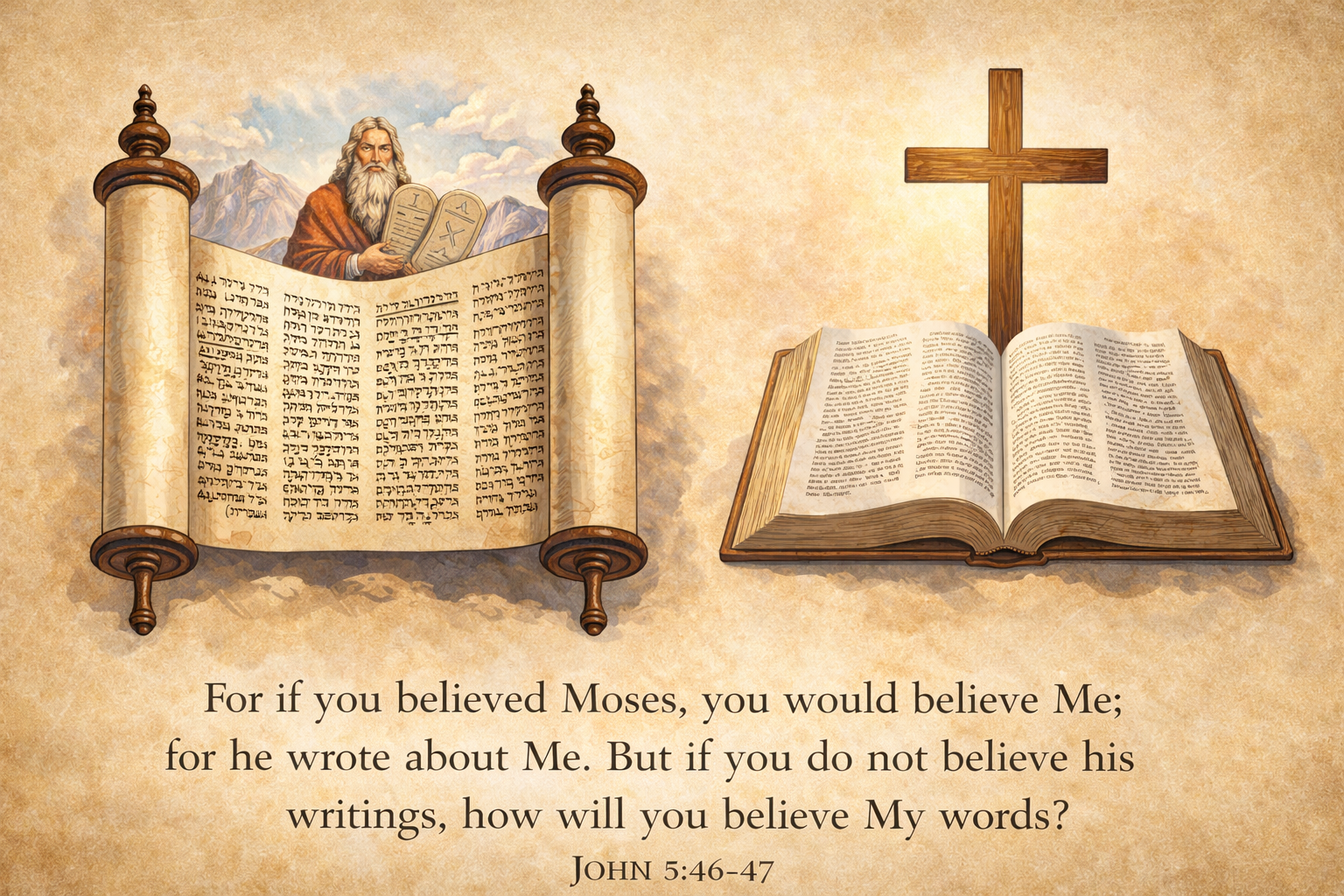
Jesus Himself declared:
“If you believed Moses, you would believe Me, for he wrote of Me. But if you do not believe his writings, how will you believe My words?” — John 5:46–47
Deuteronomy 34:10–12 summarizes Moses’ unparalleled role:
“There has not arisen a prophet since in Israel like Moses, whom the LORD knew face to face… for all the signs and wonders… and all the mighty power… that Moses did in the sight of all Israel.”

So What’s the Point?
The point is simple—and essential:
Moses recorded God’s historical account of the origin of the universe and the earliest history of the earth.
And Moses’ testimony was:
- Given by God
- Authenticated by God
- Confirmed by miracles
- Affirmed by Jesus
- Preserved by Scripture
According to Moses—and therefore according to God—creation happened in six regular days, what we call 24‑hour days, not millions or billions of years. The biblical timeline places creation not much more than 6,000 years ago.
Modern speculations about evolution and deep time—promoted by skeptics over the last century or two—are imaginary fiction, not biblical truth. Rejecting Moses’ testimony is not a harmless academic disagreement. It is rejecting the Word of God—and inviting God’s judgment.

Martin Luther’s Warning Still Applies Today
In Luther’s day, some theologians struggled to believe that God took six days to create the universe. Luther responded with clarity and conviction:
“When Moses writes that God created Heaven and Earth… in six days, then let this period continue to have been six days… If you cannot understand how this could have been done in six days, then grant the Holy Spirit the honor of being more learned than you are… Since God is speaking, it is not fitting for you to turn His Word in the direction you wish it to go.”
Luther’s words echo the heart of the issue:
We do not stand over Scripture. Scripture stands over us.
Trust the God Who Spoke to Moses
Moses’ life, miracles, and writings all point to one truth:
God has spoken—and His Word is trustworthy.
The same God who parted the Red Sea, fed His people with manna, and spoke to Moses face to face is the God who tells us how the world began.
And the same God who created the universe by His Word is the God who redeems us through His Son, the Word made flesh.
When we trust Moses, we trust Christ.
When we honor Scripture, we honor the Creator.
And when we believe God’s account of creation, we stand on the firm foundation of His eternal truth.
.